How does a Tier-1 automotive supplier bring AI into the plant floor?
By using a hypervision AI contextual verification layer to detect drift, correlate signals, and cut incident response.
Sector
Manufacturing
Country
France
Use case
Automotive Hypervision
4
to digital twin
7 × lower cost
to scale
3–5 × faster
content updates
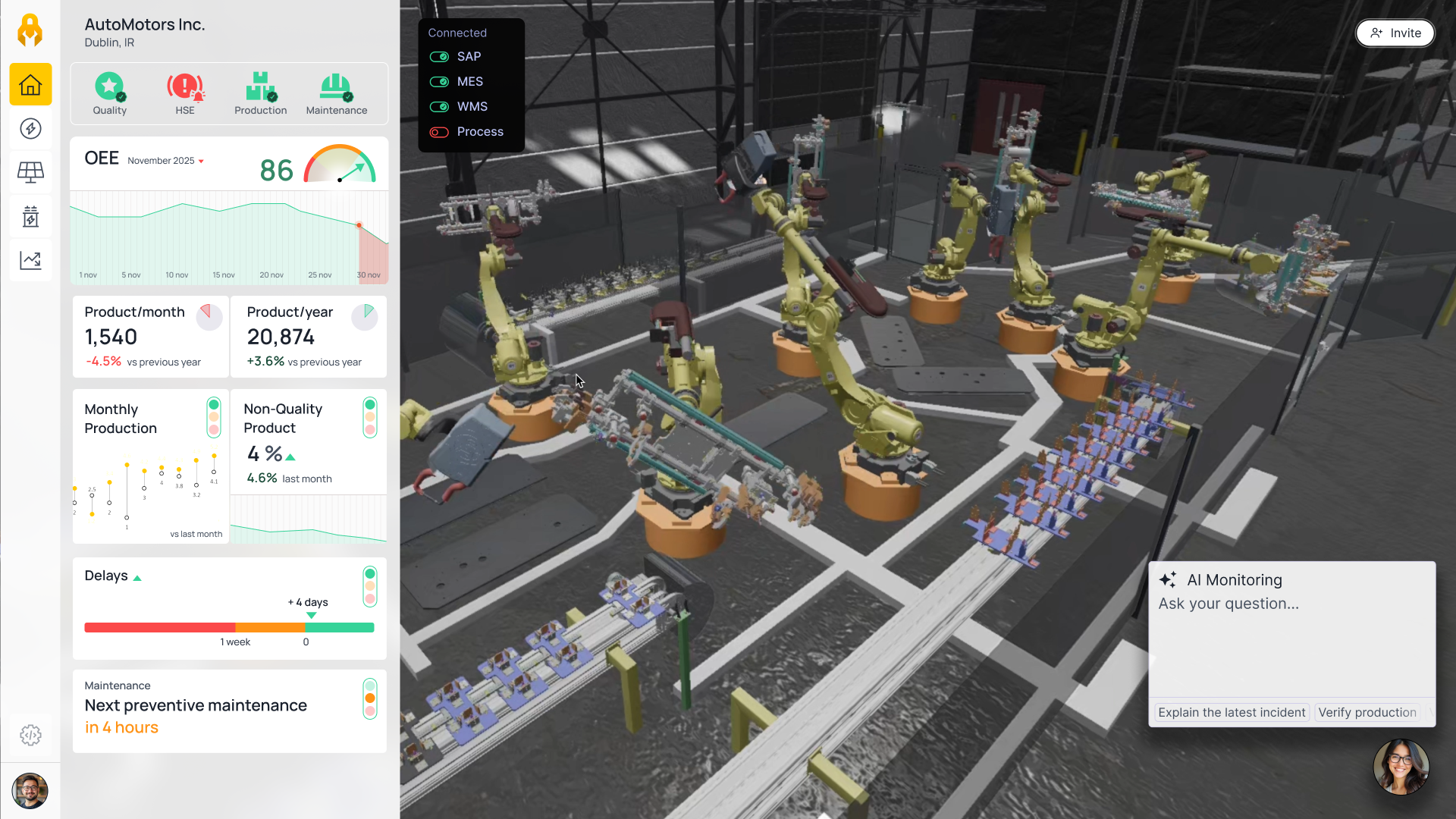
When a safety alert fires, everyone needs the same picture — instantly
Running a multi-line automotive plant means managing a constant tension: keep throughput up, keep people safe, keep systems talking to each other. When those priorities collide — when an HSE incident hits a line that's already behind schedule and running overdue on maintenance — the people who need to make decisions are rarely in the same room, and rarely looking at the same data.
That's the gap Hypervision is built to close.
Hypervision connects to existing plant infrastructure — SAP, MES, WMS, process systems — without replacing any of it. Rather than adding another siloed tool to the stack, it acts as the layer that unifies them, reconciling data from each source into a single spatial model of the facility that reflects what's actually happening on the floor in real time.
The result is an environment where every system's data has a location. A machine isn't just a row in a spreadsheet or a node in a process graph — it's a physical object in a 3D model, and clicking on it surfaces everything relevant: its current state, its contribution to OEE, its place in the production schedule, its maintenance history. The spatial model becomes the shared interface between operators, supervisors, quality teams, HSE managers, and plant directors — regardless of which underlying system their data originally lived in.
From alert to action, without the coordination lag
When an HSE incident occurs, Hypervision surfaces it directly in the spatial model — not as a generic notification, but as a located event with full operational context already attached. Which line. Which cell. What OEE looks like at that moment. Whether delays are already accumulating. Whether maintenance is scheduled or overdue.
Everyone with access sees the same picture at the same moment — on the floor, in the office, or remote. There's no waiting for a report to run, no calling around to piece together what each system is showing. The information needed to make a decision is already assembled, in one place, the moment the alert fires.
That's the shift Hypervision makes possible: from detection to coordinated response, with no translation layer in between.
AI that knows where it is
Hypervision doesn't bundle its own AI — and that's intentional. Instead, 3dverse provides the visualization and spatial coordination layer that lets you connect the AI tools you already use, or choose to deploy, directly inside the digital twin. Your AI assistant surfaces its answers in context: anchored to a location on the plant floor, alongside the live operational data from your connected systems.
The difference this makes is significant. An AI query about a line delay or an HSE event isn't answered in isolation — it's answered inside the spatial model, where the full operational picture is already assembled. Whatever intelligence you bring to Hypervision, it operates on unified, located, real-time data rather than a single system's partial view.
The bigger shift
Most digital transformation projects in industrial settings promise a unified view and deliver another dashboard. Hypervision is different because the spatial model isn't a reporting layer sitting on top of operations — it's the operational layer itself. It's where alerts live, where context is built, where decisions get made, and where responses get coordinated.
For plant managers, that means fewer blind spots and faster response when things go wrong. For HSE teams, it means incidents are visible, located, and contextualized the moment they occur. For executives and remote stakeholders, it means plant floor reality is accessible without a site visit or a manually assembled report.
Industry 5.0 isn't about replacing human judgment with automation. It's about making sure the right people have the right information at the right moment to exercise that judgment effectively. That's what Hypervision delivers — not as a future promise, but as a live operational reality.