Showroom virtuel
How Siemens Created a Digital Twin of a Digital Experience Center with 3dverse?
By establishing 3dverse as the real-time 3D twin layer of their Saclay showroom, they can achieve true bidirectional orchestration between physical assets and virtual environments.By establishing 3dverse as the real-time 3D twin layer of their Saclay showroom.

Sector
Manufacturing
Country
France
Use case
Virtual Showroom
The Challenge
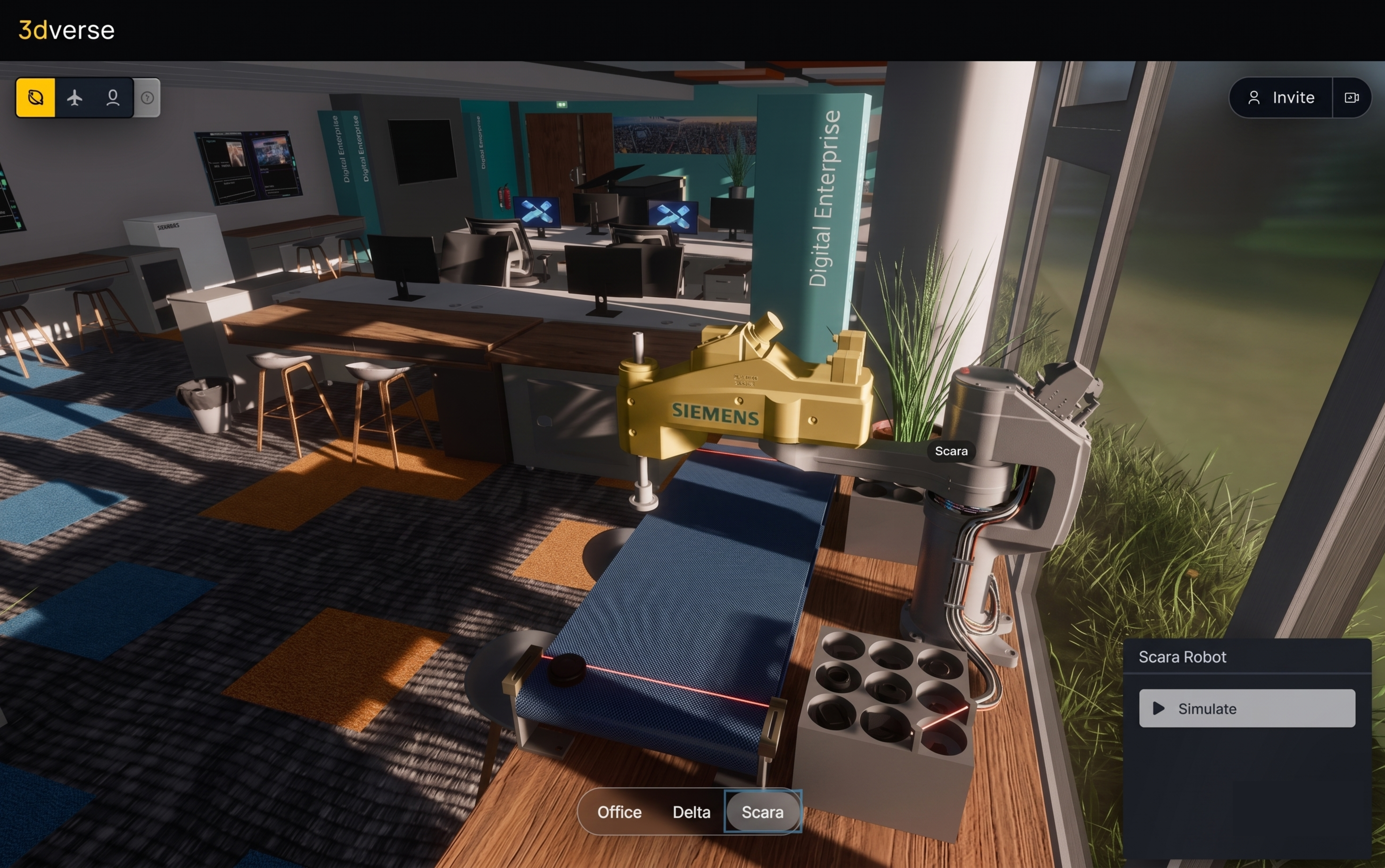
Siemens' Digital Experience Center (DEX) in Saclay, France is one of their most powerful commercial assets — a physical space where clients and partners can witness industrial automation and robotics come to life. Seeing a robot move, a sequence run, a system respond in real time is worth more than any brochure or slide deck.
But that experience has always been anchored to one place. Getting value from the DEX meant getting people to Saclay — coordinating travel, schedules, and availability across teams and geographies. For a global customer base, that friction adds up fast. Deals slow down. Training gets delayed. And the full impact of what Siemens can do never quite reaches the people who need to see it.
The Solution
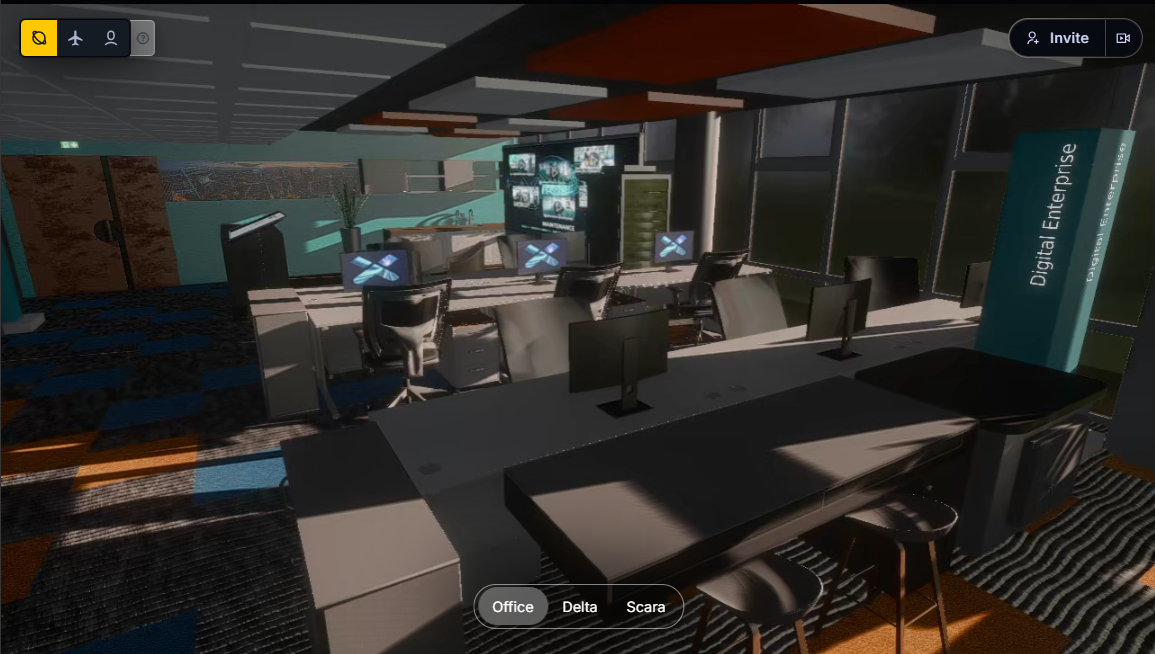
Industrial showrooms are often limited by physical geography, restricting access to a fraction of global clients. To overcome this limitation for the Siemens DEX (Digital Experience Center) in Saclay, 3dverse provides the foundational, real-time 3D twin layer.
Instead of acting as a static 3D model or a heavy, localized application, 3dverse streams a live, faithful replica of the physical showroom directly to the cloud. Rather than building or aggregating the underlying logic from scratch, 3dverse connects existing, high-fidelity industrial data streams right onto this browser-native spatial layer. By driving the 3D canvas with real simulation data, the twin allows global teams and clients to experience the exact movements and behaviors of the Saclay floor from anywhere in the world.
The Core Capability: Physical & Digital Parallel Performance
The robots in the virtual environment don't just look like their real counterparts—they move, behave, and respond like them.
01 — True Kinematic Behavioral Fidelity
The System Connection: The 3D layer bridges directly with industrial communication protocols (OPC UA) and behavioral simulation software (SIMIT).
The 3D Realization: Because the virtual assets are driven by the exact same simulation data powering the physical floor, every joint rotation, cycle speed, and operational state is mirrored withotu latency in the 3D space.
02 — Universal Streaming
High-fidelity 3D assets usually require powerful graphics workstations, creating a massive barrier for sales teams and clients.
The System Connection: Native 3dverse cloud-rendering engines handle the heavy processing upstream.
The 3D Realization: The entire Saclay environment streams securely to any browser on standard enterprise hardware. Users can access the live twin via desktop, mobile, or XR headsets with zero software to install and no local hardware performance requirements.
03 — Global Collaborative Walkthroughs
Coordinating international client reviews or cross-regional engineering alignments traditionally requires expensive travel or fragmented screen-sharing sessions.
The System Connection: Built on a multiplayer-ready architecture that synchronizes user sessions in real time.
The 3D Realization: A sales team in Tokyo, a client in Munich, and an engineer in Montreal can all walk through the same live Saclay showroom at the same time. Each user can explore independently, yet all view the exact same robotic behaviors simultaneously.
The Outcome
The Siemens DEX digital twin proves that physical distance is no longer a barrier to experiencing advanced industrial automation. By leveraging 3dverse as a high-performance, cloud-streamed 3D layer, Siemens breaks its showroom out of its physical constraints in Saclay. By connecting live OPC UA and SIMIT data directly to an open, browser-accessible canvas, they created a powerful tool for global sales, collaborative engineering, and interactive client engagement—running seamlessly across one physical location, and infinite digital ones.
Open the demo