Robotics
How VLM Robotics Enables Remote Supervision of Industrial Welding Robots
By connecting robotic welding cells to immersive digital twins for monitoring, diagnostics, and remote control.
Sector
Robotics
Country
France
Use case
Manufacturing 5.0
Robotic Arc Welding in Semi-Automatic Production
Industrial arc welding robots — including Wire Arc Additive Manufacturing (WAAM) systems — operate in semi-automatic production protocols. The robot executes a program while a human operator supervises the process. This combination of automation and human oversight is essential: the process is precise, the equipment is complex, and unexpected events can halt production at any moment.
In this environment, the machine cell integrates a robot and positioner, a CNC controller (Sinumerik Operate), a welding system with dedicated arc cameras and microphone, and a full sensor array measuring arc voltage, welding current, wire speed, temperature, and acoustic signal. When everything runs nominally, the semi-automatic protocol holds. The problem arises when it does not.
The Core Problem
Unexpected events regularly force the semi-automatic protocol to break down. These events require a trained expert to diagnose the situation, decide on the correct action, and guide or execute a recovery. The problem is that such experts are not always physically present when and where they are needed.
Without a qualified expert on site, the operator faces a situation where the machine is stopped, the cause may not be obvious, and the recovery procedure requires specialist knowledge — probing, block restart, tool change, TCP re-calibration, or parameter correction.
Events that trigger the breakdown
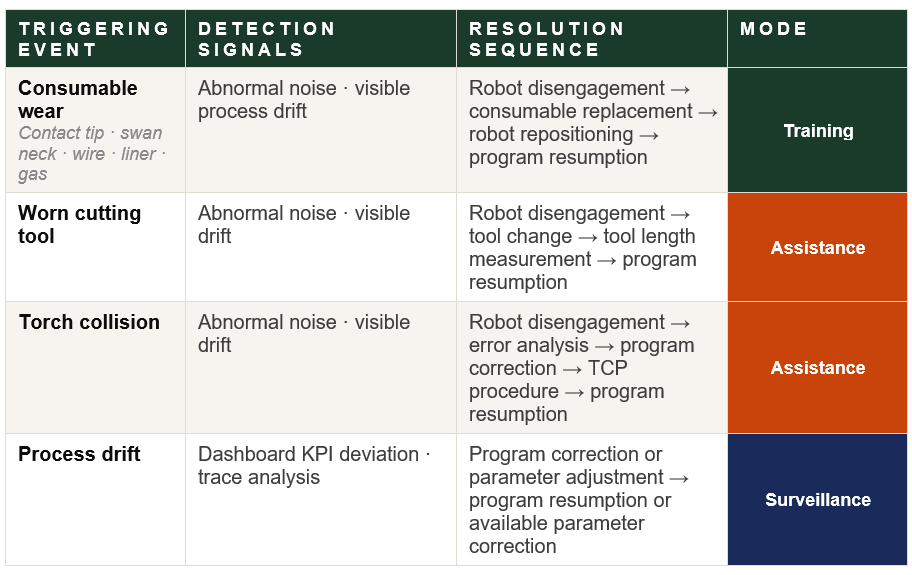
– Consumable wear: contact tip, swan neck, wire, liner, gas
– Worn cutting tool: requiring disengagement, replacement, and length measurement
– Torch collision: requiring error analysis, program correction, and TCP auto-calibration
– Process drift: requiring dashboard analysis and parameter or program adjustment
Each incident type has a defined resolution chain: the detection signal (abnormal noise, visible drift) leads to diagnosis, which leads to a set of physical actions, which leads to program resumption. Executing this chain requires both visual access to the machine and expert-level judgement.
A 3D Digital Twin of the Machine Cell
To address this challenge, VLM Robotics, a Siemens partner, leveraged the 3dverse platform to create a live digital twin of its robotic welding cell. The immersive environment (that can be accessed on VR) will combine real-time camera feeds, a synchronized 3D replica of the machine, live CNC data, and operational KPIs into a single interface. By providing remote experts with complete visibility into machine behavior, process conditions, and production performance, the solution will enable faster diagnostics, guided interventions, and remote operational support without requiring physical presence.
Beyond incident recovery, remote supervision also addresses a critical dimension that is often overlooked: part certification. In arc welding and WAAM processes, the manufactured part must meet strict qualification parameters (weld geometry, heat input, interpass temperature, deposition rate) that are defined by the certification protocol. A process drift that is not caught in time does not just halt production; it can push the part outside its certified envelope, making it non-conformable and potentially unsalvageable.
The VR environment's continuous monitoring of process KPIs; acoustic signal, arc voltage, current, wire speed, and trajectory — gives a remote expert the means to identify, in real time, any deviation that risks compromising certification compliance. Intervening before tolerances are exceeded preserves both the part and the traceability record, avoiding costly scrapping or re-qualification procedures.
Four Ways to Use the Platform
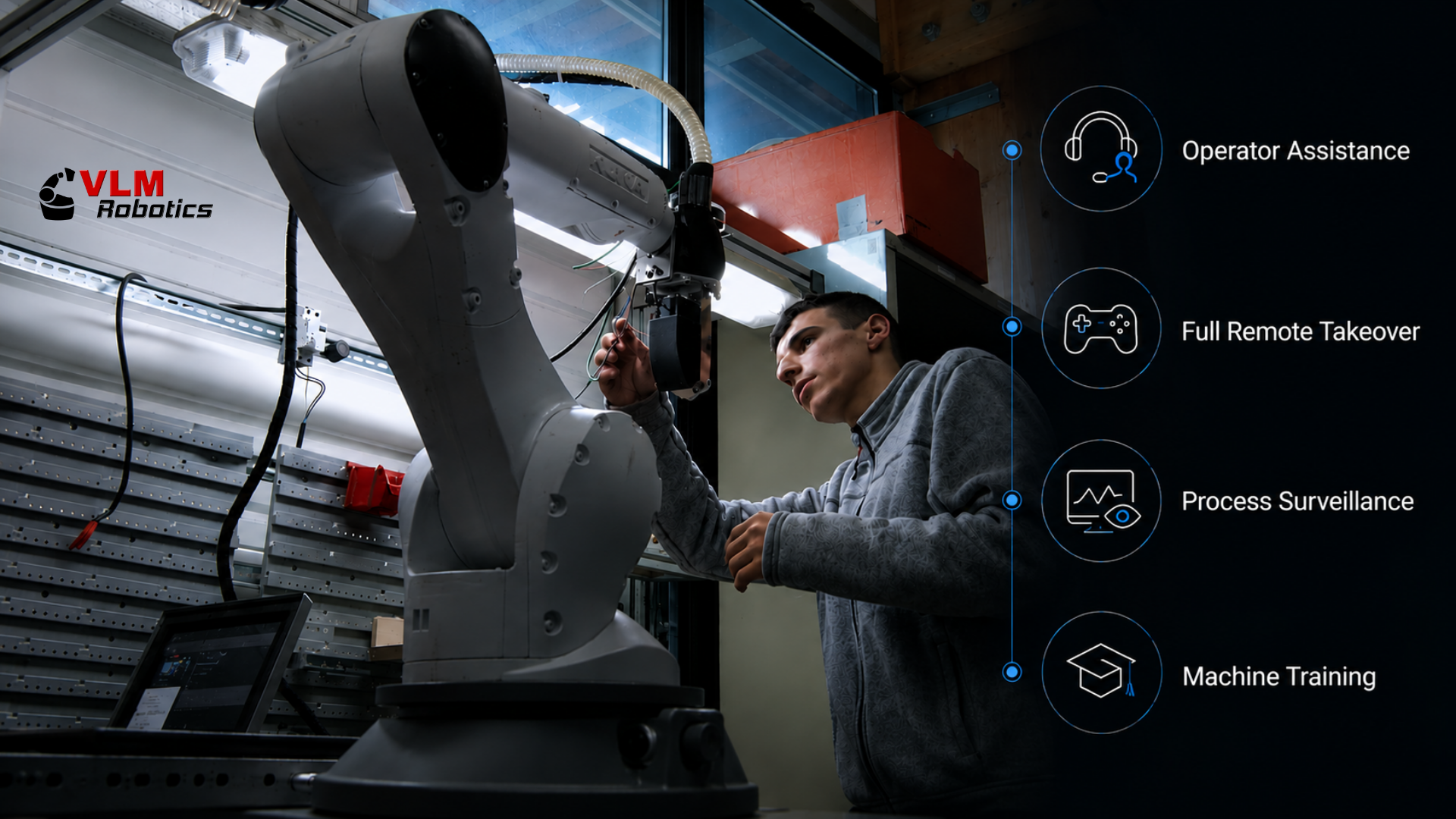
The VR environment supports four distinct modes of use, covering the full spectrum from situational guidance of an on-site operator, through to complete machine operation by a remote expert with no one present on the floor.
Remote Operator Assistance
A remote expert connects to the VR environment and guides an operator who is physically present at the machine but faces a situation beyond their expertise. The expert sees the same live feeds and data as if they were standing there, and can direct the operator step by step.
Full Remote Takeover of the Machine
When no trained operator is available on site, a remote expert can launch and fully control a production program from the VR environment. This mode requires the future TCM / custom HMI currently under development.
Remote Process Surveillance by Expert
An expert monitors a running production process from a remote location, without physical intervention unless a drift is detected on the dashboard or cameras. When a deviation appears, they act directly through the environment.
Remote Machine Training
Knowledge transfer between a remote expert and an on-site operator, conducted through the VR environment in a guided and safe context.
Unexpected Events — From Detection to Resolution
Every incident type follows the same structured chain: an event is detected through abnormal noise or a visible process deviation, the expert diagnoses it using the VR environment, a resolution sequence is executed, and the program is resumed or corrected.
Unexpected Events — From Detection to Resolution
Every incident type follows the same structured chain: an event is detected through abnormal noise or a visible process deviation, the expert diagnoses it using the VR environment, a resolution sequence is executed, and the program is resumed or corrected.
All four incident types are detectable through the environment's live camera feeds and process dashboard — giving the remote expert the same diagnostic information they would have on-site, without being physically present.
This use case illustrates a fundamental shift in industrial operations: moving from site-dependent expertise to expertise-on-demand. Through the integration of a live digital twin, real-time machine data, and immersive remote access, VLM and 3dverse have created an environment where experts can understand, diagnose, and support production processes from anywhere in the world.
The result is not only faster response times and improved operational resilience, but a scalable framework for the future of manufacturing—where physical assets, digital environments, and human expertise operate as a single connected system.