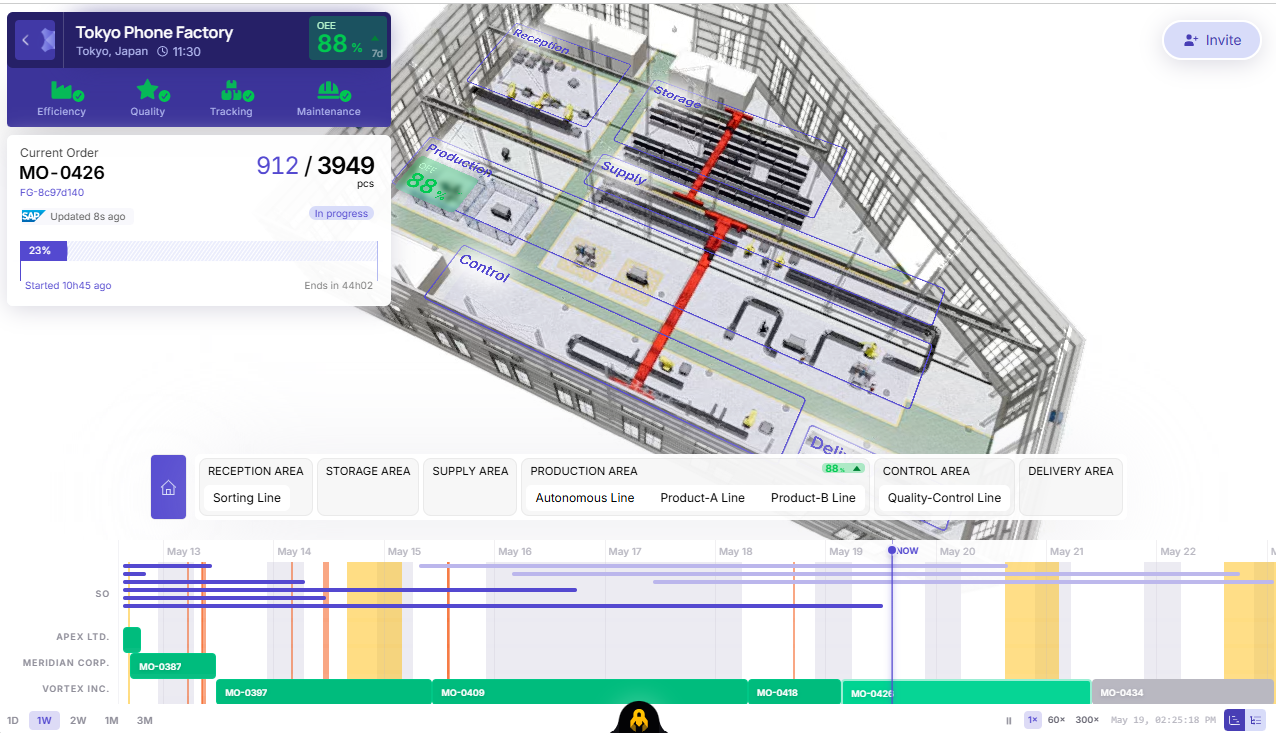
How 3dverse's Persistent Real-Time 3D Digital Twin Is Rewiring Industrial Operations
Walk into almost any factory, distribution center, or mine site and you'll find the same story repeating itself: a dozen different systems, each holding a fragment of the truth. ERP knows the orders. MES knows the production schedule. WMS knows where the inventory sits. SCADA and PLCs know what the machines are doing right now. IoT sensors know the vibration, temperature, and throughput. CMMS knows when the conveyor last broke down. QMS knows which batch failed inspection.
Each of these systems is excellent at its job ; and each one is blind to everything outside it. When a plant manager wants to see what's happening across a site, someone ends up stitching together spreadsheets, dashboards, and tribal knowledge. Often, IT teams rebuild the same data connections, and the same visualization logic from scratch. That's expensive, slow, and it doesn't scale.
3dverse's answer to this is architectural, not cosmetic: build one persistent digital twin, connect it once to the systems of record, and let every operational application draw from that same living model.
What 3dverse actually is
At its core, 3dverse is a real-time 3D engine and platform-as-a-Service built for industrial-scale digital twins among use cases. It's designed to ingest spatial and operational data from the systems already running a business, render it in real time at scale (think entire plants, warehouses, or mine sites, not just a single machine), and expose that live model to any number of downstream applications through APIs and SDKs.
The distinction matters. Most "digital twin" projects today are actually digital twin instances — a one-off 3D model built for a single use case, disconnected from live data, and abandoned once the demo is over. 3dverse's premise is that the twin should be persistent: always on, always synchronized with the real world, and always available as a foundation other teams and tools can build on top of.
The interoperability layer: connect once
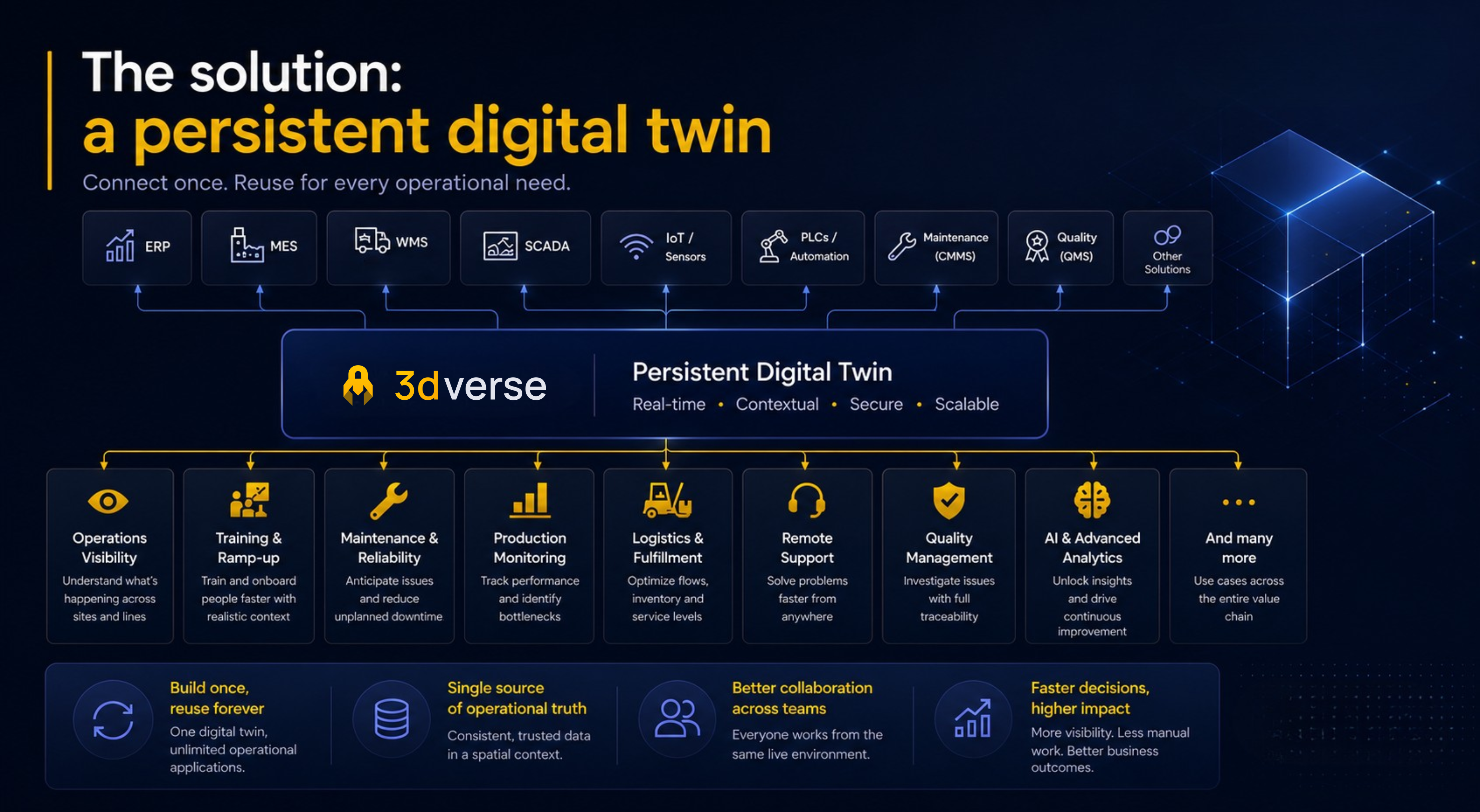
Look at the top of the architecture and you'll see the systems every industrial operation already runs on:
ERP — orders, planning, financials
MES — production execution and scheduling
WMS — warehouse and inventory operations
SCADA — supervisory control of industrial processes
IoT / Sensors — real-time telemetry from equipment and environments
PLCs / Automation — the control layer running the machines themselves
CMMS — maintenance history and work orders
QMS — quality records and inspection data
and whatever "other solutions" a given industry runs on top of that stack
None of these systems are going away, and 3dverse isn't trying to replace them. Instead, it sits below them as a connective layer, pulling structured operational data out of each system and binding it to the correct spatial and contextual location inside the 3D model. A vibration reading from an IoT sensor doesn't just become a number on a dashboard — it becomes a colored overlay on the exact conveyor bearing it came from. A work order from the CMMS doesn't just sit in a ticket queue — it's pinned to the physical asset it belongs to, in context, in 3D.
This is the technical heart of the "connect once, reuse for every operational need" idea. The integration work — the hard, unglamorous plumbing between ERP/MES/SCADA and a spatial model — happens once, at the platform level.
The persistent digital twin: six properties that matter
3dverse describes the twin itself along six dimensions, and each one is doing real engineering work, not just marketing:
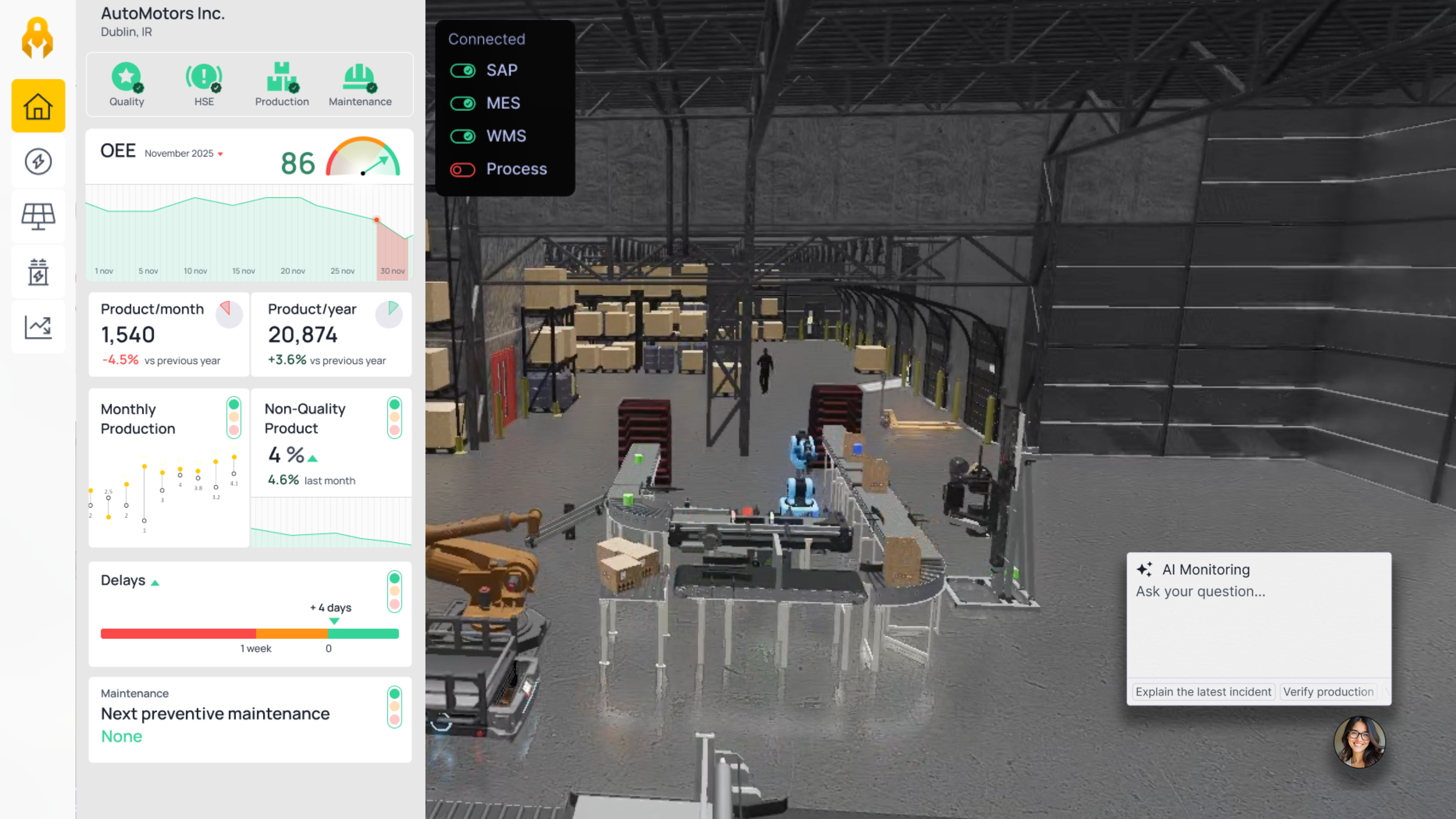
Real-time. The twin reflects the current state of operations, not a static snapshot from last quarter's CAD export. Sensor values, machine states, and inventory positions update live.
Contextual. Data isn't just collected — it's placed. A temperature reading means something different next to a motor than next to a loading dock, and the twin preserves that spatial and operational context rather than flattening everything into generic dashboard tiles.
Secure. Because the twin aggregates data from ERP, SCADA, and control systems, it has to meet the access-control and data-governance standards of industrial environments, not consumer software.
Scalable. The architecture has to handle the geometry and data density of real industrial sites — multi-hectare plants, sprawling warehouses, mine sites spanning kilometers — not just a single hero asset rendered for a sales demo.
Collaborative. A digital twin only becomes valuable when it can be shared across teams. Engineers, operators, maintenance technicians, executives, suppliers, and remote experts should all be able to access the same live environment simultaneously, each with the permissions and tools relevant to their role.
Accessible. Cloud-native by design, the twin is available from virtually anywhere without requiring specialized workstations, VPN-heavy deployments, or high-end graphics hardware. Whether accessed from a browser on a laptop, a tablet on the factory floor, or a mobile device in the field, users can securely interact with the same real-time environment, reducing barriers to adoption and enabling faster collaboration across sites and organizations.
Build once, reuse forever: the business case
This is where the architecture translates into the bottom line. In the schema 1.0, the bottom row — Operations Visibility, Training & Ramp-up, Maintenance & Reliability, Production Monitoring, Logistics & Fulfillment, Remote Support, Quality Management, and AI & Advanced Analytics — isn't a list of separate products. It's a list of applications sharing one underlying twin.
Traditionally, each of those capabilities would be its own project: its own data integration, its own 3D content pipeline, its own maintenance burden. With a persistent twin as the foundation, adding a new use case becomes an application-layer problem, not an infrastructure problem. That has four downstream business effects 3dverse calls out directly:
Single source of operational truth — every team, from the shop floor to the exec dashboard, is looking at the same live, spatially accurate data instead of reconciling conflicting reports.
Better collaboration across teams — operations, maintenance, quality, and logistics stop working from siloed tools and start working from the same live environment.
Faster decisions, higher impact — less time spent manually assembling context means more time spent acting on it.
Lower marginal cost per use case — because the expensive part (connecting and modeling the site) is already done, each new application is materially cheaper and faster to ship than the last.
Training AI on the twin: the most underrated part of the stack
The "AI & Advanced Analytics" box in the diagram is easy to skim past, but it's arguably the highest-leverage use case sitting on top of a persistent digital twin — because the twin isn't just a place to visualize AI outputs, it's a place to generate the data that trains the models in the first place.
This matters because industrial AI has a chronic data problem. Computer vision models that need to spot a cracked conveyor idler, a misaligned pallet, or a near-miss between a haul truck and a light vehicle require thousands of labeled examples of exactly those events — and real industrial sites don't produce dangerous or rare failures on demand. Predictive maintenance models need years of sensor data leading up to a bearing failure, but most assets only fail once. Waiting to collect that data from the real world is slow, expensive, and in some cases means waiting for accidents to happen.
A persistent digital twin breaks that bottleneck in a few concrete ways:
Synthetic data generation at scale. Because the twin is a real-time 3D rendering of the actual site, it can generate photorealistic synthetic images and sensor streams — camera feeds, LIDAR, thermal — under conditions that are rare, dangerous, or simply haven't happened yet. A model that needs to recognize a spilled load on a haul road, a fire, or a safety-zone breach can be trained on thousands of simulated variations (different lighting, weather, angles, equipment states) without waiting for those events to occur naturally or staging them physically.
Automatic, perfect labeling. Because digital twins already knows the exact position, geometry, and identity of every asset in the scene, synthetic data comes out pre-labeled — bounding boxes, segmentation masks, depth maps, and object classes are generated alongside the imagery instead of requiring manual annotation. This removes one of the largest cost centers in computer vision training pipelines.
Closing the sim-to-real gap with live data. Because the twin is persistent rather than a one-off simulation, it's continuously reconciled against real sensor feeds from SCADA, IoT, and PLCs. That live grounding means synthetic training data stays anchored to actual site conditions — real equipment geometry, real material behavior, real environmental patterns — rather than drifting into a generic simulation that doesn't transfer to the real plant or pit.
Historical replay for predictive models. Every maintenance event logged in the CMMS, every quality deviation in the QMS, and every sensor trend leading up to those events lives inside the same contextual model. That turns the twin into a queryable historical record — teams can replay the sensor conditions in the weeks before a crusher failure or a batch rejection and use that time-series data to train predictive maintenance and quality models with proper ground truth, rather than reconstructing timelines by hand across five disconnected systems.
Reinforcement learning in a safe sandbox. For use cases like autonomous haul route optimization, robotic picking, or dynamic scheduling, the twin provides a physically accurate environment where an RL agent can run millions of simulated iterations — testing strategies against realistic physics and real operational constraints — before any policy is deployed on physical equipment.
Continuous model improvement, not a one-time training run. Because the twin stays synchronized with live operations, it doesn't just train a model once and go stale. As the physical site changes — new equipment, reconfigured layouts, shifting mine geometry — the twin updates with it, and models can be retrained or fine-tuned against current conditions instead of a snapshot from months earlier.
For an industry like mining, this is especially high-value: safety-critical events (equipment collisions, ground instability, fires) are exactly the scenarios you most need a model trained on and least want to generate by waiting for them to happen in real life. Generating them synthetically, from a twin that's grounded in the real site's geometry and live sensor behavior, is the practical way to build robust AI without compromising safety to collect training data.
In short: the same "connect once, reuse forever" logic that applies to operational applications applies just as strongly to AI. The twin isn't just where models get deployed — it's the engine that produces the labeled, contextual, continuously updated data those models are trained on.
NB: 3dverse is the platform, not an AI/ML training service. 3dverse itself doesn't run model training pipelines, own a machine learning framework, or ship pretrained models — its job is to be the real-time, persistent, contextual digital twin: the connected, always-on 3D environment and the data it generates. Everything described above (synthetic data generation, automatic labeling, historical replay, RL sandboxing) is a capability enabled by that platform, built on top of it by a data science or ML team using their own tools — TensorFlow, PyTorch, a cloud ML service, whatever the stack is. This is consistent with the platform's broader positioning: 3dverse is the foundation other applications are built on, not a vertically integrated app for every use case itself.
Why this matters strategically
The industrial software market has spent the last decade proliferating point solutions — one tool per problem, one integration per tool. That approach hits a ceiling fast: integration cost compounds, data stays siloed, and organizations end up maintaining ten disconnected "sources of truth" instead of one.
3dverse's bet is that the winning architecture looks like the internet stack rather than the point-solution stack: a shared, persistent layer (the digital twin) that many applications are built on top of, the same way countless products are built on top of a shared cloud or database layer rather than each reinventing storage and compute.
Connect the operational systems once. Model the physical world once. Then let operations visibility, training, maintenance, logistics, quality, and AI-driven analytics all draw from that same living foundation — in a mine, a factory, a warehouse, or anywhere else physical operations and digital systems need to meet.
That's the strategic core behind "connect once, reuse for every operational need" — and it's the difference between a digital twin as a demo and a digital twin as infrastructure.