Silicon Valley Advanced Manufacturing and Industry 4.0 Canadian Technology Accelerator
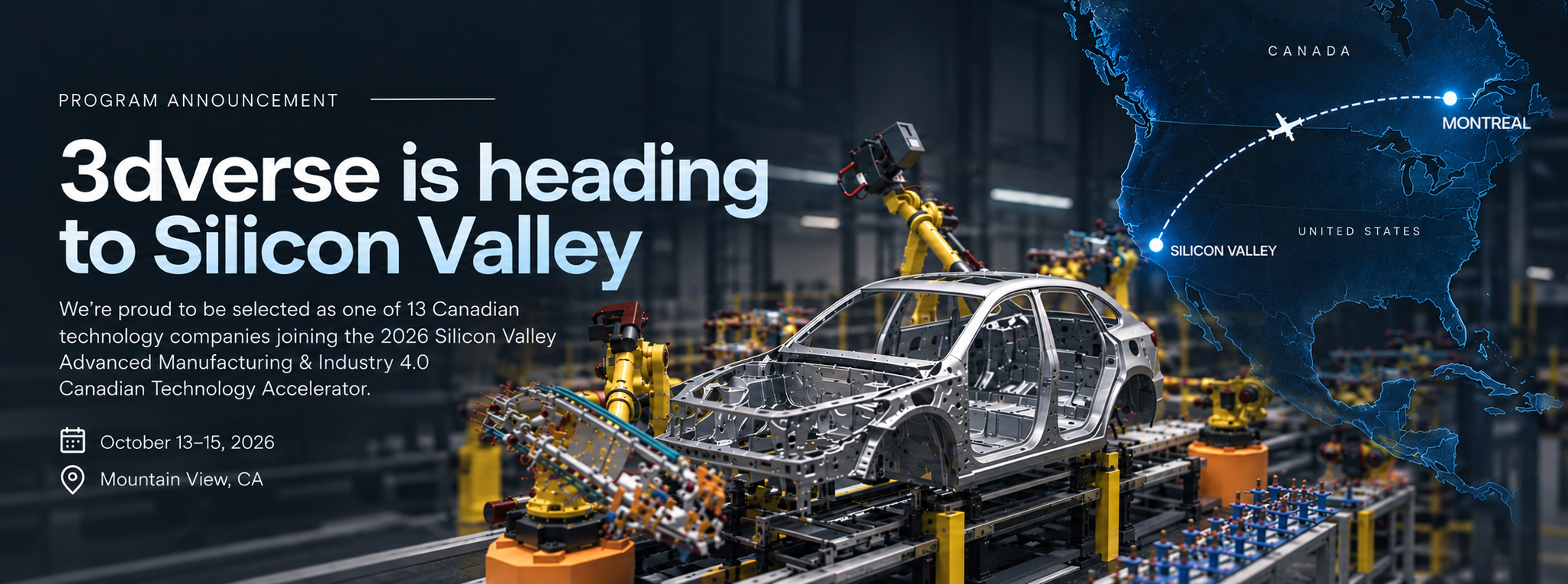
3dverse Heads to Silicon Valley: Building the Next Generation of Industrial Digital Twins
3dverse has been selected as one of 13 Canadian technology companies joining the 2026 Silicon Valley Advanced Manufacturing & Industry 4.0 Canadian Technology Accelerator (CTA) — a milestone that puts our real-time 3D digital twin platform directly in front of the OEMs, Tier 1–3 suppliers, and corporate venture capital teams shaping the future of industrial automation.
From October 13–15, 2026, our team will be in Mountain View and the greater San Francisco Bay Area, connecting with investors, technology scouts, and manufacturing leaders to talk about where industrial digital twins and spatial computing are headed next.
Why This Matters for the Future of Digital Twins
Silicon Valley's appetite for advanced manufacturing technology has shifted. Tech scouts and corporate venture teams — particularly those tied to automotive and consumer electronics — are no longer just looking for flashy prototypes. They want solutions that make hardware scalable, resilient, and economically viable, with a clear path from proof of concept to real-world deployment.
That shift is exactly where 3dverse operates. Corporate innovation teams are actively investing in:
Automation and robotics
Advanced materials and power electronics
Precision manufacturing
AI-enabled production systems
Digital twin technology that connects the physical and digital worlds in real time
For industrial digital twins specifically, this means the bar has moved. It's no longer enough to render a static 3D model of a factory floor or a piece of equipment. The technology has to close the loop between 3D visualization and live operational data — and it has to do it at scale, across devices, and across teams.
Beyond Visualization: What a Real Digital Twin Platform Needs to Do
At 3dverse, we believe the next generation of digital twins needs to solve three problems that have historically kept 3D technology siloed inside engineering and design teams:
1. Connecting 3D Environments to Operational Data
A digital twin isn't just a pretty replica — it's only as valuable as the data flowing through it. Real-time 3D infrastructure needs to ingest sensor data, IoT feeds, and operational metrics and reflect them visually and contextually inside a live 3D environment, so operators, engineers, and decision-makers are looking at the same source of truth.
2. Making 3D Accessible Across the Organization
Traditional 3D and CAD tools require specialized hardware and specialized skills. For digital twins to actually drive Industry 4.0 outcomes — faster time to market, reduced supply chain risk, better electrification and production planning — they need to be accessible to plant managers, executives, and field teams, not just 3D specialists. That means browser-based, cloud-streamed, cross-device access to complex industrial environments.
3. Scaling and Collaborating in Real Time
Modern manufacturing operations span multiple facilities, suppliers, and geographies. A digital twin platform needs to support multiple users interacting with the same 3D environment simultaneously — collaborating on the same live data, in real time, regardless of where they're physically located.
This is the thesis 3dverse will be bringing to Silicon Valley: real-time 3D infrastructure as the connective layer between physical operations and digital decision-making.
An Impressive Cohort of Canadian Industry 4.0 Innovators
3dverse is proud to represent Canadian spatial computing technology alongside 12 other companies selected for the 2026 cohort, spanning advanced display technologies, industrial AI, robotics, machine vision, indoor positioning, and supply chain intelligence:
Halion — Advanced Display Technologies / Functional Nanomaterials
Estare Inc — Industrial Packaging Systems / Smart Manufacturing & Logistics
Xaba Inc. — Industrial AI / Robotics & Factory Automation
ZeroKey Inc. — Indoor Positioning / Industrial Digital Twins
Sheba Microsystems Inc — MEMS / Machine Vision & Imaging Sensors
3dverse — Digital Twins / Spatial Computing
4D1 (SpatialFlo) — Digital Twins / Spatial Computing
Cyberworks Robotics Inc. — Autonomous Mobile Robots / Autonomous Navigation Software
Rbot9 — Industrial Robots / Warehouse & Factory Automation
Ma Robot AI — Industrial Robotics & Autonomous Systems
Exhilarare (stealth) — Advanced Manufacturing Software / Industrial Process Automation
TetraGen Robotics — Industrial Robotics / AI-Powered Welding
Lytica — Supply Chain Intelligence / Electronics Procurement Software
3dverse will be on the ground, demoing our real-time 3D digital twin platform and having direct conversations with OEMs, Tier 1/2/3 suppliers, and corporate VCs about integration readiness and manufacturability.
Looking Ahead
Digital twins are moving from a visualization nice-to-have to core infrastructure for Industry 4.0 — and that shift requires 3D technology that's built for real-time data, cross-device accessibility, and collaboration at scale. Representing Canadian spatial computing technology in Silicon Valley is a chance to show how far real-time 3D infrastructure has come, and where it's headed next.
Want to see what a real-time 3D digital twin platform looks like in action? Get in touch with the 3dverse team or follow along as we head to Mountain View this October.