Virtual Geometry: Powering Persistent Digital Twins at Scale
How 3dverse streams massive point clouds into real-time 3D environments using virtual geometry, intelligent caching and GPU memory management.
Digital twins are becoming increasingly sophisticated. From industrial facilities and infrastructure to autonomous robotics, organizations need to visualize, simulate and interact with increasingly large and complex 3D environments.
But there is a fundamental technical challenge: how do you render a digital twin containing billions of 3D points when the available GPU memory can hold only a fraction of the dataset?
By combining hierarchical spatial data structures, multi-tier caching and Vulkan sparse memory, 3dverse can stream the geometry required for a particular viewpoint without loading the entire environment into GPU memory.
The result is an approach that supports large-scale 3D visualization and creates a shared spatial environment for both human users and robotic simulations.
1. From a LiDAR Scan to a Persistent Digital Twin
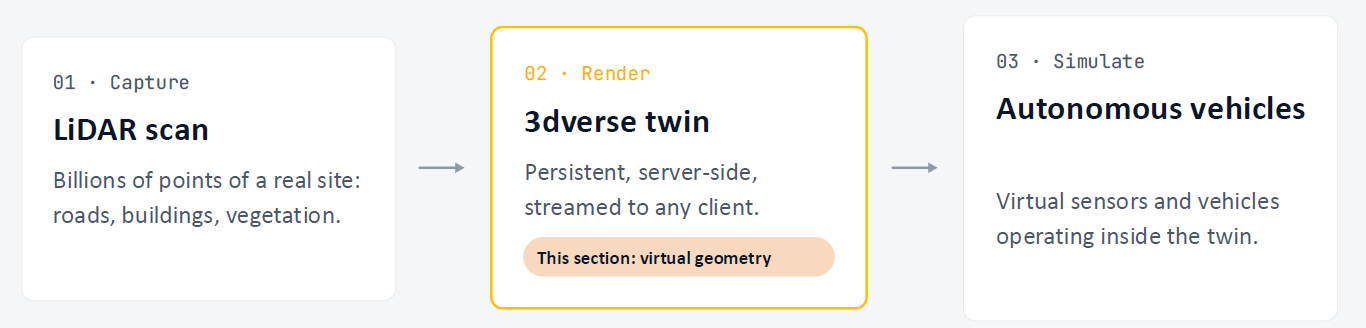
From physical environments to interactive simulation
Creating a digital twin of a real-world environment begins with capturing its physical geometry.
LiDAR scanning can produce detailed point clouds representing roads, buildings, industrial equipment, vegetation and surrounding infrastructure. Depending on the scale and resolution of the capture, these datasets can contain billions of individual points.
However, capturing an environment is only the first step. To make the data useful, it must become accessible to applications that can visualize, analyze and interact with it.
3dverse connects three stages of this process.
Capture: Digitize the physical environment
LiDAR scanners capture the geometry of a real-world site and produce a point cloud representing its spatial structure.
These datasets provide the foundation for creating digital replicas of complex physical environments.
Render: Create a persistent 3D environment
3dverse transforms the captured data into a persistent, server-side digital twin.
Instead of requiring each device to download and process the complete dataset, rendering takes place on the server, and the resulting experience is streamed to connected clients.
This allows applications to access large 3D environments through the web.
Simulate: Bring robotics into the digital twin
The same environment can be used by simulations of autonomous vehicles and robotic systems.
Virtual cameras and simulated sensors operate within the digital twin, using the same underlying geometry as the visual environment.
The objective is a single, consistent spatial environment in which what a human sees corresponds to what a simulated sensor reads.
This consistency is particularly important for robotics, where perception, navigation and simulation depend on accurate spatial information.
2. The Challenge: Massive Datasets, Limited GPU Memory
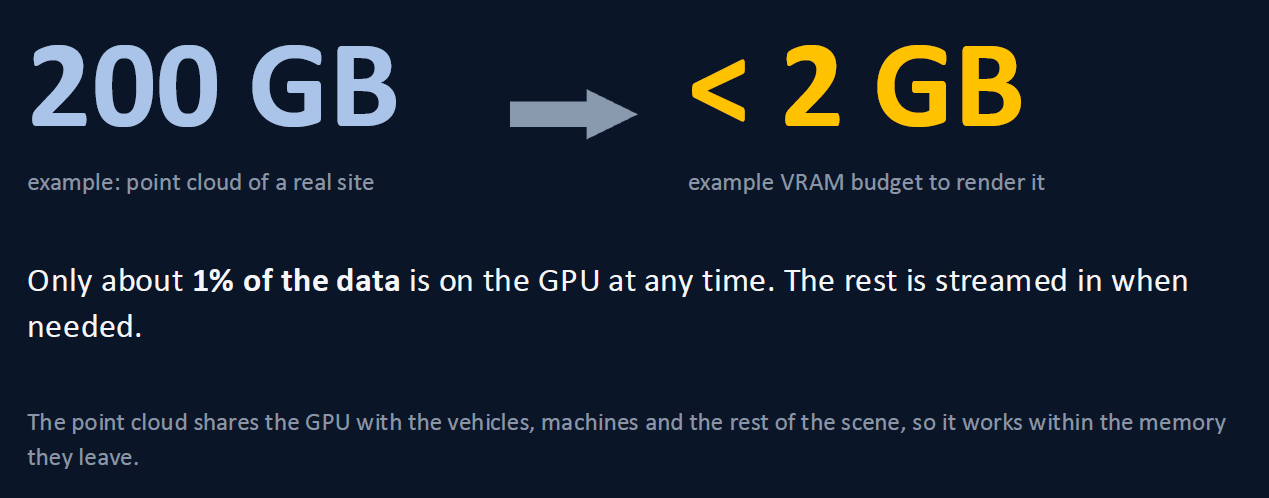
What happens when a 200 GB point cloud needs to run within a 2 GB GPU memory budget?
High-resolution point clouds can be significantly larger than the GPU memory available to render them.
Consider the example presented at SC26:
200 GB: Size of the point cloud representing a real-world site.
Less than 2 GB: Example GPU memory budget available for rendering the point cloud.
Approximately 1%: Proportion of the total dataset that can reside in GPU memory at a given moment.
Traditional approaches that depend on loading an entire dataset into GPU memory become impractical at this scale.
The challenge is even greater in interactive digital twins, where the GPU must also process vehicles, machines and other elements of the scene.
The solution is not simply to increase GPU memory. It is to fundamentally change how geometry is stored, accessed and rendered.
3dverse addresses this challenge by loading only the geometry needed at a given moment, while keeping the rest of the dataset accessible through a hierarchy of storage and caching resources.
As users navigate the environment, the system dynamically brings relevant geometry into GPU memory and releases geometry that is no longer required.
This allows the digital twin to operate within the memory available rather than requiring the entire dataset to fit on the GPU.
3. How 3dverse Makes Massive 3D Datasets Accessible
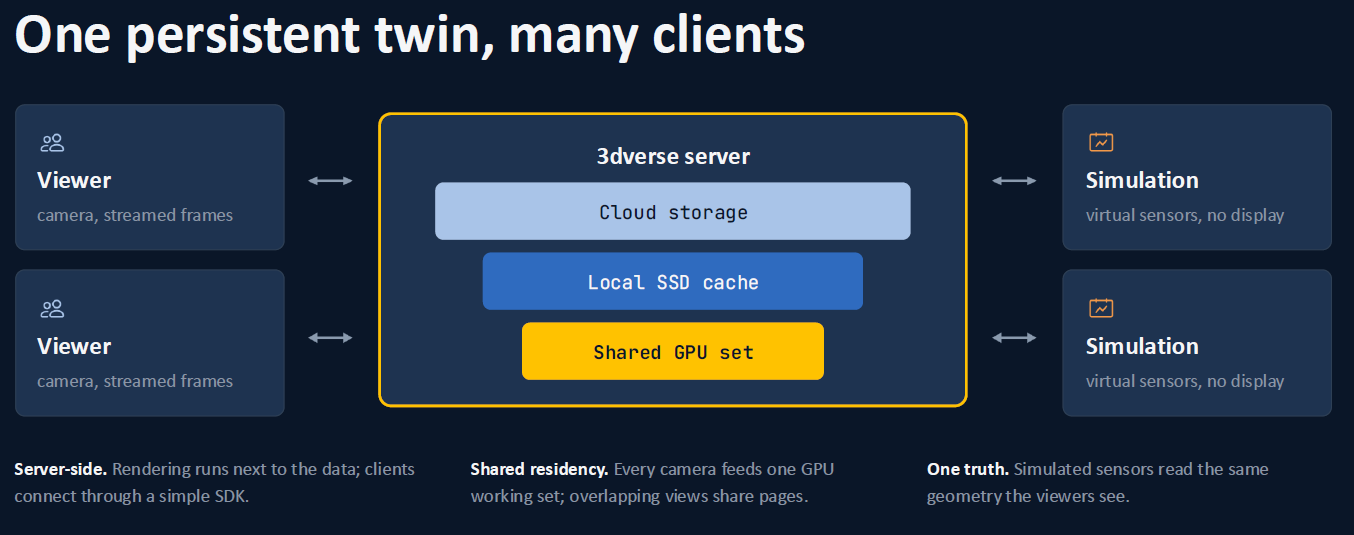
Rather than loading an entire point cloud into GPU memory, 3dverse uses a virtual geometry architecture that retrieves and renders only the data needed at a given moment.
The approach relies on three core technologies:
Hierarchical geometry: Large point clouds are divided into smaller spatial units, organized into multiple levels of detail. This allows the system to prioritize the geometry relevant to the current viewpoint.
Intelligent caching: Data moves through a three-tier architecture — cloud storage, local SSD and GPU memory. The system keeps frequently accessed geometry close to the GPU while retrieving additional data as needed.
Vulkan sparse memory: Physical GPU memory is dynamically assigned to geometry as it becomes necessary, avoiding the need to load or reorganize the entire dataset.
Together, these technologies allow 3dverse to work with data.
4. One Persistent Digital Twin for Visualization and Simulation
The benefits of virtual geometry extend beyond rendering large point clouds.
In 3dverse, the digital twin runs server-side, where multiple users, applications and simulations can access the same underlying 3D environment.
Human operators can navigate the digital twin through web applications, while simulated autonomous vehicles and virtual sensors interact with the same geometry.
Because the environment is persistent, overlapping viewpoints can reuse geometry already loaded into GPU memory rather than maintaining separate copies for each user.
This creates a shared spatial foundation for applications such as robotic simulation, remote supervision and industrial visualization.
One environment. Multiple viewpoints. A consistent source of spatial information.
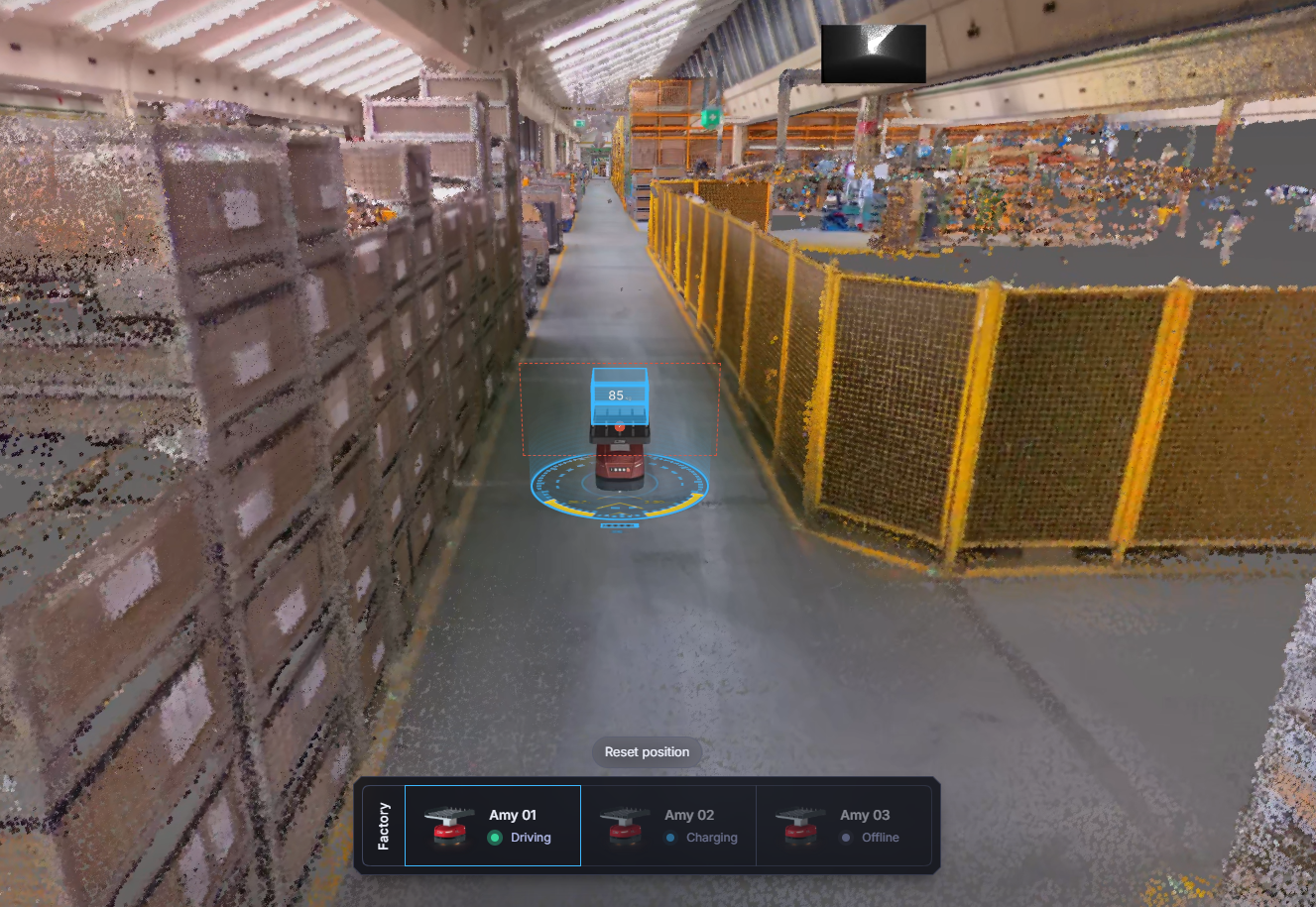
Building the Next Generation of Digital Twins
Virtual geometry represents an important step toward making massive 3D datasets practical for interactive applications.
By managing geometry dynamically across cloud storage, SSD and GPU memory, 3dverse provides the underlying 3D infrastructure developers need to build applications without managing the complexity of large-scale rendering themselves.
From industrial visualization to robotics and simulation, the objective remains the same: make complex 3D environments accessible, interactive and scalable through the web.