How does ALTEN connect the real and virtual worlds for Industry 4.0 with low latency?
ALTEN, a global leader in engineering and technology consulting, partnered with 3dverse to drive Industry 4.0. Together, they are transforming industrial operations through real-time digital twins and immersive cloud-based solutions.
Sector
Industrial Metaverse
Country
France
Use case
Smart Factory
MQTT & OPC UA
integration
From Industrial Data to Prescriptive Action: AI Inside the Digital Twin
ALTEN, a global leader in engineering and technology consulting, is using 3dverse to explore a new model for industrial operations: one where AI is not another system sitting alongside the factory, but is integrated directly into a live, real-time 3D representation of operations.
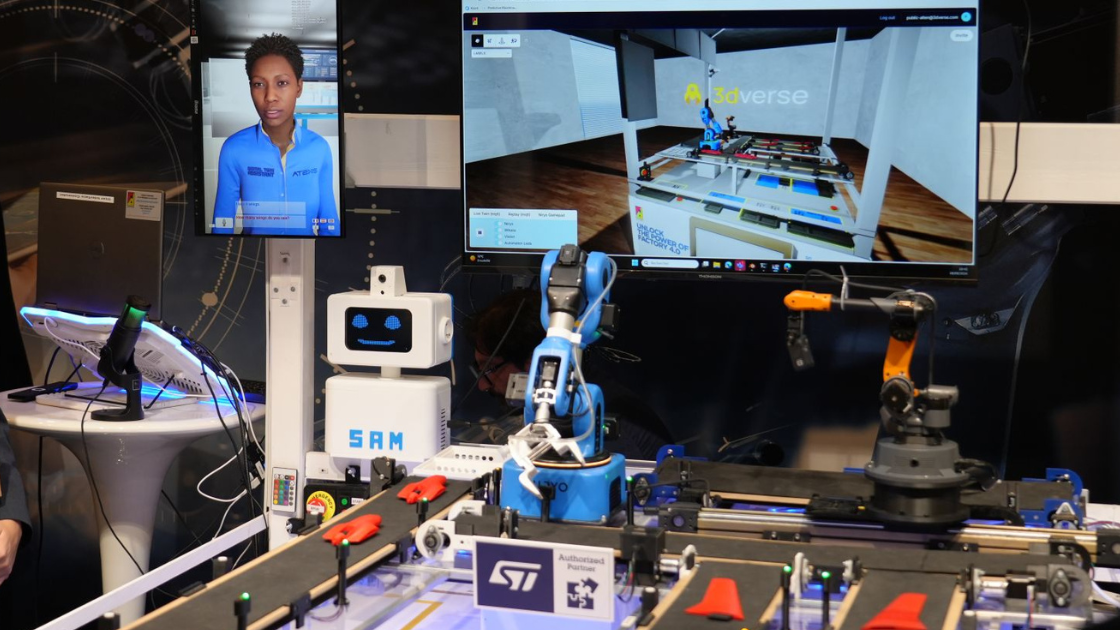
Using ALTEN’s Mini Plant 4.0 as a reference smart factory, the project combines live industrial data, AI and real-time 3D to detect operational anomalies, contextualize them within the physical production environment, and give teams the information they need to act.
The result is more than a visualization of the factory. It is an operational environment designed to move industrial teams from reactive monitoring toward prescriptive operations.
The Challenge: Industrial AI Without Operational Context
Modern factories generate enormous amounts of data across machines, sensors, PLCs, MES, ERP and other industrial systems.
AI can analyze that data and identify anomalies, but there is still a critical gap between detecting a problem and understanding what it means operationally.
Information is often distributed across dashboards and disconnected systems. An operator may know that a machine is behaving abnormally without immediately seeing:
Where the issue is occurring
Which equipment or component is affected
What other systems or processes are connected to it
How the anomaly relates to the current state of production
What action should be prioritized
In environments where unplanned downtime can cost tens or hundreds of thousands of euros per hour, reducing the time between detection, understanding and action can have significant operational value.
The Use Case: AI-Powered Anomaly Detection in a Live Digital Twin
ALTEN's Mini Plant 4.0 provides a real, instrumented industrial environment for testing how AI, industrial data and digital twins can work together.
3dverse provides the real-time 3D infrastructure layer connecting these systems into a shared operational environment.
Live machine data from the physical production line is streamed into the digital twin through industrial protocols such as MQTT and OPC UA.
AI models can analyze this operational data to identify abnormal machine behaviour.
Instead of sending the resulting alert to another isolated dashboard, the information can be contextualized directly inside the 3D environment.
Teams can immediately understand what is happening, where it is happening and which physical asset is affected.
This creates a continuous operational loop:
Physical equipment → Live industrial data → AI analysis → 3D contextualization → Operational action
What the System Enables
Live Anomaly Detection
Operational data from the Mini Plant is continuously connected to the digital twin, allowing AI-generated anomalies or machine conditions to appear in the context of the live production environment.
Rather than searching across systems to locate an issue, teams can associate intelligence directly with the equipment generating it.
AI Contextualized in 3D
AI becomes significantly more useful when its output can be connected to the physical context of operations.
3dverse provides the spatial layer that connects machine data, AI insights and industrial assets within the same environment.
An anomaly is no longer simply an alert or data point. It can be understood in relation to the machine, production line and surrounding operational environment.
From Detection to Prescriptive Action
The objective is not simply to predict that something may go wrong.
By combining AI analysis with real-time operational context, teams can move toward determining what is happening, what is likely to happen next and what action should be taken.
This creates a path from:
Reactive maintenance → Predictive intelligence → Prescriptive action
A Shared Operational Environment
Because 3dverse is cloud-native and streamed through the web, the same environment can be accessed by engineering, operations, maintenance or remote experts without requiring the industrial dataset to be processed locally on each device.
Teams can collaboratively investigate an issue inside the same synchronized digital twin, whether they are accessing it from a workstation, tablet, mobile device or immersive interface.
Why 3dverse
The role of 3dverse is not to replace ALTEN's AI, industrial systems or operational applications.
It provides the real-time 3D infrastructure that brings them together.
Instead of creating another dashboard or another isolated application, 3dverse provides a persistent spatial environment where industrial data, AI outputs and physical assets can be connected and accessed in context.
This allows ALTEN to experiment with new industrial workflows without rebuilding the underlying 3D infrastructure for every application or use case.
The Operational Shift
The ALTEN Mini Plant 4.0 demonstrates a broader evolution in industrial digital twins:
From fragmented data → contextual intelligence
From anomaly alerts → operational understanding
From reactive maintenance → prescriptive action
From dashboards → spatial operational systems
From AI connected to operations → AI deployed inside operations
The value of the digital twin is no longer simply seeing a virtual representation of the factory.
It is creating an operational layer where people, industrial systems, real-time data and AI can work together in context.
Building Toward the Factory of the Future
Through Mini Plant 4.0, ALTEN and 3dverse are demonstrating how real-time 3D infrastructure can serve as the foundation for increasingly intelligent industrial applications.
The project provides a practical environment for testing how AI can move beyond analytics and become part of day-to-day industrial decision-making — helping manufacturers detect problems earlier, understand them faster and ultimately take better-informed action.
This is not another interface for industrial AI. It is an environment where AI becomes operational.
We aim to demonstrate that a digital twin architecture not only optimizes performance management but also enables immersive training and research within a virtual factory. This includes ergonomic simulations, failure analysis, and enhanced physical workflows.
François Portier
Director of the Smart Factory 4.0 research programme - ALTEN